If you are turning equity or pre-IPO wealth into a New York home, you are probably already working through the tax and structuring questions with a CPA, a tax attorney, and a wealth advisor. Good. This guide covers the part that is actually ours: the real estate.
What to buy, how to hold title to a home, how the New York process and costs work, and how the purchase fits the broader plan your advisors are building. Think of Undivided as the real estate seat at that table, and as the people who help you assemble the rest of it.
One boundary up front, because it matters. I am a licensed real estate broker. I am not a CPA, a tax attorney, or a financial advisor, and nothing here is tax, legal, or investment advice. Where the bigger strategies come up, I will point you to the professionals who own them. What I will go deep on is the real estate, because that is what you came here for.
You are probably here in the middle of a bigger journey
Most people who reach this page have already been reading about something else. Trusts. Capital gains and QSBS. The timing of a sale. How to hold assets. Those are real and important questions, and they belong with your accountant and your attorney. What is much harder to find is a clear, honest read on the real estate piece from someone who does this every day in New York. That is the gap this is meant to fill.
So I am going to stay in my lane on purpose. I will name the strategies that surround a purchase so you know what to ask your advisors, then spend the real time on the decisions that are genuinely ours to guide.
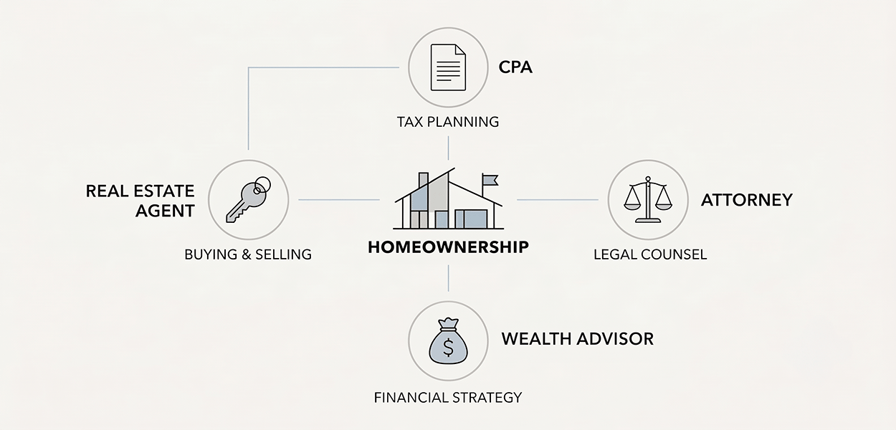
Who does what on your team
A purchase like this works best when a few specialists each play their position. Here is how I think about the roster.
|
Role |
What they own |
You should ask them about |
|
CPA or tax advisor |
The tax picture |
Capital gains planning, depreciation on investment property, entity tax treatment, timing |
|
Tax or estate attorney |
Legal structures |
Trusts, entity formation, estate planning, how a sale is documented |
|
Wealth advisor or lender |
Liquidity and financing |
Diversification, and financing approaches that may let you buy without selling everything |
|
Undivided (us) |
The real estate |
What to buy, what it is truly worth, how to negotiate it, how to hold a home, and getting to a clean close |
We are the real estate experts on that team, and we are happy to introduce you to trusted CPAs, attorneys, and advisors when you do not already have them. The point of the team is simple. You should not be taking tax advice from your broker, and you should not be taking real estate advice from your accountant.
The real estate decisions that are actually ours
This is where we earn our keep, and where the detail belongs.
Condo versus co-op. Roughly two-thirds of Manhattan’s apartment stock is co-ops, run by boards that can reject buyers, scrutinize finances in detail, restrict LLC and pied-a-terre ownership, and limit financing. For a buyer whose wealth is concentrated in company stock rather than a long salary history, co-ops are often impractical. Condos accommodate non-traditional income and asset profiles, allow flexible ownership, and close on a predictable timeline. For most buyers in this situation, condos are the path. It is still a fit question worth talking through, not a blanket rule.
How you hold title to the home
This one is squarely a real estate decision, which is why I will be specific. Many buyers in this position choose to own through an LLC. The reasons are practical: privacy, since your name stays off the public record, liability separation, and easier transfer of interests down the road. Condos generally permit LLC ownership and co-ops generally do not, which is one more reason this buyer leans toward condos. Some buyers hold title in a trust instead, or an LLC owned by a trust, usually for estate planning continuity. Your attorney forms and documents whichever structure you choose, but deciding to buy in a building and a way that allows it is a real estate decision, and it needs to be made before you go into contract, because changing it mid-deal is expensive.
Choosing the right building, not just the right apartment
Two apartments side by side, same line, same finishes, will not necessarily trade or appreciate the same. The unit seduces you. The building decides the outcome. We dig into the building’s financials and reserve fund, the sponsor’s track record, the amenity-to-unit ratio that governs whether common charges stay stable, the board and bylaws, and how price per square foot, including outdoor space, compares to true value. Most agents price outdoor space poorly, which is its own opportunity. This is the entire reason we built the Undivided Value Index.

Negotiation and the real cost to close
New York closing costs are higher and structured differently than what many buyers expect. There is the NYC mansion tax, which runs from 1 percent up to 3.9 percent on purchases of a million dollars or more. There is the mortgage recording tax, roughly 1.8 to 1.925% of the loan on financed purchases. On new development, buyers are often asked to pay the sponsor’s transfer taxes and attorney fees, which can add 2% or more, and which are negotiable. New York transactions are also attorney-driven. Knowing where the leverage is and managing the personalities on the other side of the table is a big part of what you are hiring us for.
Buying without selling everything: a real estate note, not a financing pitch
A question I hear constantly is whether you have to sell stock and trigger a tax bill to buy. Often, you do not. There are financing approaches that let some buyers borrow against their assets rather than liquidate them, and there are mortgages underwritten on assets rather than salary. The structure, the rates, and whether any of it is right for you is a conversation for your lender and your financial advisor. My job is to make sure the property and the deal are sound, and to keep the transaction on track once you and your advisors choose how to fund it.
The strategies that live with your other advisors
I want to name these, so you know what to ask about, and then leave them with the people licensed to handle them. Depending on your situation, your CPA and attorney may discuss capital gains planning, which for some early employees can include the QSBS exclusion, depreciation strategies on investment property, diversification or deferral vehicles, and charitable or estate planning structures. Some of these can be significant. None of them are mine to advise on, and the right move is almost always to have that conversation before a sale rather than after. If you do not have those advisors yet, that is one of the first ways we can help, by introducing you to specialists who do this work for tech clients.

A real example: an engineer who built a real estate portfolio
Here is a client story that shows the team approach in action.
He is an engineer. His company went public, and he wanted to move some of the proceeds into real estate rather than leave everything in a single concentrated position. His accountant had a plan for the tax side, including a depreciation strategy on investment property, and that plan stayed firmly with his accountant. My job was the real estate: sourcing the right income-producing properties, evaluating them honestly, and negotiating and closing them. We have now done this together several times, most recently a cash-flowing rental in Williamsburg with a strong rate of return.
The lesson I take from working with him is the mindset, not any one tactic. A windfall can be capital to put to work, and real estate is one durable place to do it. The tax structuring belonged to his accountant. The property decisions belonged to us. That division of labor is exactly how it should go.
The order that keeps it all working together
The sequence matters. Assemble the team before you fall in love with a unit, so a CPA, an attorney, your financial advisor or lender, and your buyer’s broker are all in place. Let your advisors set the tax and financing plan. Then we go to work on the real estate: identifying the right building, guiding how you hold title in coordination with your attorney, negotiating the all-in number, and getting you to a clean close. We have run this play many times, including with a tech founder couple we guided into a Gramercy penthouse, where careful valuation and negotiation produced more than a million dollars in savings against the asking price.
The bottom line
If you are turning equity into a New York home, you do not need your broker to play accountant. You need a real estate expert who understands this buyer, stays in their lane, and works cleanly alongside your CPA, attorney, and advisor. That is the role we play. We go deep on what to buy, how to hold it, and how to negotiate and close it, and we help you assemble the rest of the team around your goals.
If you are working through a move like this, or advising someone who is, we are glad to be the real estate piece of the plan.
Book a 30-minute strategy call. No pitch. Just the analysis.
Undivided Inc. is a licensed real estate brokerage. No financial, tax, or legal advice is provided in this article. Information is general and may not reflect your specific circumstances or the latest rules, so consult qualified professionals before acting.