


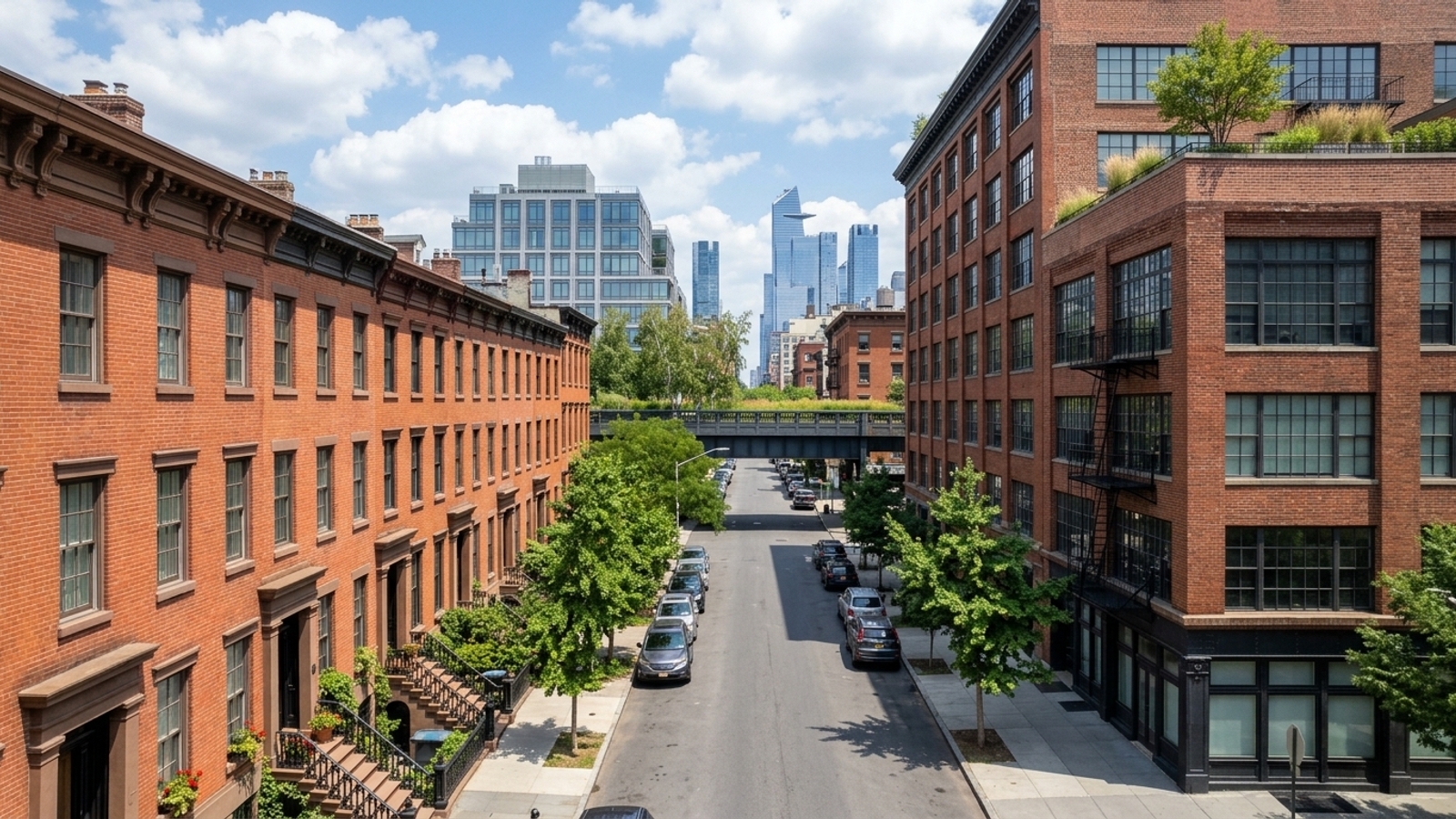
Of the neighborhoods around Hudson Yards, Chelsea is the one where current sales data shows buyers have negotiating power. Its condo median fell 13.5% year over year to $1,600,000, homes sat a median 69 days, and only 12.1% of condos sold above asking during the 90 days ending September 30, 2026.
The real choice near Hudson Yards is between paying for the newest towers inside the development, where no such data is published here, and negotiating on established Chelsea condos a few blocks south. This guide compares the surrounding areas based on building types and current market conditions.
Key Takeaway
If you're buying near Hudson Yards, start with Chelsea, directly to the south. It's the one neighboring area where current sales show buyer negotiating power, with its condo median down significantly year over year. If you want the newest towers and amenity buildings instead, look inside Hudson Yards itself and expect to judge new-development pricing and carrying costs without that negotiating data.
Who This Guide Is For
You want to buy a home within walking distance of Hudson Yards and are deciding which neighboring area fits your budget, your preferred building type, and how much room you have to negotiate.
Hudson Yards Area Housing Market Right Now
Chelsea, directly south of Hudson Yards, is where current sales data shows you have room to negotiate. Current data covers Chelsea but doesn't break out Hudson Yards, Hell's Kitchen, Midtown West, or the Meatpacking District, so the case for negotiating is documented for Chelsea alone. A median 69 days on market means sellers are waiting more than two months, which gives you time to compare and ask for terms. Buyers preparing to negotiate can find further details on buying a home in Hudson Yards.
With 5.1 months of condo supply, there's more than five months of listings at the current pace. You rarely need to rush a decision. About seven in eight condo buyers paid at or below asking price.
The median sale-to-list ratio of 99.2% tempers this. Most discounts off the final asking price are small, so your negotiating power tends to show up in timing, seller concessions, and price cuts before the final ask rather than in deep cuts at the closing table. These market figures are informational, not financial or legal advice.
Established Neighborhoods South of Hudson Yards
Moving south from the rail yards takes you into established, older, and sometimes landmarked buildings. The pre-war architecture and mid-century apartments here are a distinct contrast to the glass towers of the new development.
This direction also offers documented negotiating room, specifically in Chelsea, in exchange for a longer walk to the Hudson Yards core. Because the High Line connects these southern blocks directly to the rail yards, the commute stays entirely off the street grid.
Chelsea
This is overwhelmingly a condo market. Nearly 12 of every 13 homes sold in Chelsea last quarter were condos, accounting for 143 of 155 sales. Other property types had too few sales to report separately, so a co-op or townhouse buyer here has little current comparable data to work with.
At the condo median of $1,714 per square foot, a 900-square-foot one-bedroom works out to about $1.54 million. That baseline lets you test a listing's asking price against the neighborhood median. The High Line runs through West Chelsea to its northern end at Hudson Yards, providing a physical walking path between the two areas.
You should compare any listing's price per square foot with recent sales in the same building, because a neighborhood median blends very different properties. Worth flagging: falling prices cut both ways. The same decline that gives you room to negotiate can continue after you buy, so if you might sell within a few years, the trend is working against you.
Meatpacking District and the West Village
Much of the Meatpacking District is a city-designated historic district, known as the Gansevoort Market Historic District, designated in 2003. That shapes exactly what can be built and changed on these blocks. These streets sit at the southern end of the High Line walk to Hudson Yards.
Before making an offer, ask whether a building is landmarked and which Landmarks Preservation Commission permits a planned renovation would require. There are no current sales figures for this area, so you'll need to pull recent sales for the specific building you want.
Landmark designation means exterior changes and many interior renovations require city approval, which adds time and cost. This area is also the farthest of the five from Hudson Yards, and without current sales data, it's hard to know how much room you have to negotiate.
Neighborhoods with New Construction Near Hudson Yards
The blocks immediately surrounding the rail yards offer a completely different housing stock from the neighborhoods to the south. Here, you'll find the newest towers and the shortest walk to the 7 train.
The trade-off for that proximity is paying new-development pricing and carrying costs that current data doesn't document. There's no published negotiating data to rely on when making an offer in these buildings.
Hudson Yards
Much of Hudson Yards is built on a platform over a working rail yard, with trains still running underneath. The residential stock consists of new high-rise condo towers sold by developers, also known as sponsors. Buying new development involves reviewing an offering plan and negotiating sponsor contract terms.
Ask for the offering plan, current common charges, real estate taxes, and whether any tax abatement applies and when it ends. Current sales data doesn't cover Hudson Yards separately, so you can't point to falling prices or long days on market to justify an offer. Monthly carrying costs in new towers require careful checking building by building before you can accurately compare them with older condos in Chelsea.
Midtown West and the Garment District
Moynihan Train Hall, the expanded Penn Station concourse, opened in 2021 across from the original station at the southern edge of this area. The blocks here are a mix of residential and commercial buildings. Count the active residential listings on your target blocks before committing, because the residential choices may be narrower than in Chelsea.
There's no current sales data for this area. The residential choice on many blocks may be thin, so you may wait longer for the right listing even if prices turn out to be negotiable.
Older Buildings North of Hudson Yards
Heading north of the rail yards brings you into older, established buildings with a different zoning history. The housing stock shifts away from new development and heavy condo concentration.
Where co-ops are prevalent, you'll go through a board approval process. Just as with the new construction areas, there's no current sales data to show buyer negotiating power here.
Hell's Kitchen
Much of Hell's Kitchen falls within the Special Clinton District, a zoning district created in 1974 with its own rules on development and building changes to protect the residential character. Many older Manhattan apartment buildings are co-ops, which typically require board approval. Confirm whether a listing is a co-op or condo, and for co-ops, request the board's minimum down payment, financing rules, and sublet policy before bidding.
There are no price figures for Hell's Kitchen in the current data, so you'll need to look at recent sales for the specific building. If the building is a co-op, a board can turn down a buyer, and the review adds weeks. Financing and sublet limits can also rule out some buyers or future rental plans entirely, which is a harder constraint than price.
How to Choose a Neighborhood Near Hudson Yards
Do you want to use the current negotiating room, or is the newest building your priority? If room to negotiate matters most, read the market section and the Chelsea profile. If the newest building matters most, go to the Hudson Yards and Midtown West profiles.
Are you fine with older or landmarked buildings and the renovation rules that come with them? If yes, compare Chelsea, the Meatpacking District, and Hell's Kitchen. If you want new construction, skip to the new construction section.
Are you willing to go through a co-op board review, with its financing and sublet rules? If not, focus on Chelsea, where most recent sales are condos, and on Hudson Yards. If yes, add Hell's Kitchen.
Think about how close you need to be to the 7 train or Penn Station. The Hudson Yards and Midtown West profiles cover those details, as does the Penn Station FAQ below.
To summarize the starting points: if you want a condo near Hudson Yards with documented room to negotiate, start with Chelsea. If you want the newest building stock and the shortest walk to the Hudson Yards core, start with Hudson Yards itself. If you want the shortest trip to Penn Station and Moynihan Train Hall, start with Midtown West and the Garment District. If you want an older building and you're willing to go through a co-op board review, start with Hell's Kitchen.
New York City public school assignment depends on the exact address, so check it in the NYC Department of Education's MySchools search. For safety data, look up NYPD CompStat figures for the precinct covering the address and compare the same period year over year. New York City purchases carry their own transfer and closing costs, and you should get a cost estimate from your attorney.
At a Glance
- Chelsea median sale price, all homes: $1,694,525, down 8.4% year over year (90 days ending 2026-09-30)
- Chelsea median sale price, condos: $1,600,000, down 13.5% year over year (90 days ending 2026-09-30)
- Chelsea homes sold: 155 all homes, of which 143 were condos (90 days ending 2026-09-30)
- Chelsea median days on market: 69 for all homes and for condos (90 days ending 2026-09-30)
- Chelsea median sale-to-list ratio: 99.2% for all homes and for condos (90 days ending 2026-09-30)
- Chelsea share sold above list: 12.5% of all homes, 12.1% of condos (90 days ending 2026-09-30)
- Chelsea months of supply: 5.2 for all homes, 5.1 for condos (90 days ending 2026-09-30)
- Chelsea homes for sale (inventory): 265 all homes, 238 condos (90 days ending 2026-09-30)
- Chelsea median price per square foot: $1,708 for all homes, $1,714 for condos (90 days ending 2026-09-30)
Hudson Yards Neighborhood FAQs
Which Part of New York Is Hudson Yards?
Hudson Yards is on Manhattan's Far West Side. The Special Hudson Yards District spans the far West Side of Manhattan between roughly West 28th/30th Street and West 43rd Street, from Eighth Avenue to the Hudson River.
Is Hudson Yards Considered Midtown?
Hudson Yards is its own city-designated district on the Far West Side, often grouped with Midtown West. It falls within Manhattan Community District 4, which is comprised of Chelsea, Clinton/Hell's Kitchen, and Hudson Yards.
Is Hudson Yards in Chelsea?
Hudson Yards borders West Chelsea to the south, and both sit in Manhattan Community District 4, but they are separate neighborhoods. The High Line connects them, wrapping around the Hudson Yards development at its northern terminus.
Is Hudson Yards a Good Area to Live In?
The MTA opened the 34 St-Hudson Yards 7 train station on September 13, 2015. The Hudson Yards development provides 14 acres of public open space as part of its overall footprint. The housing stock consists of new high-rise condos, and you should ask for the offering plan, current common charges, and real estate taxes.
How Safe Is Hudson Yards, NYC?
Chelsea, including the Hudson Yards area, is patrolled by the 10th Precinct of the New York City Police Department. You can look up CompStat 2.0 figures by precinct and compare the same period year over year. Precinct totals in areas with heavy visitor traffic reflect more than residents alone.
Is Hudson Yards an Expensive Place to Buy a Home?
In neighboring Chelsea, the all-homes median sale price is $1,694,525, down 8.4% year over year. Current data doesn't report Hudson Yards separately, so you'll need to pull building-level sales to see specific condo prices.
How Far Is Hudson Yards from Penn Station?
Hudson Yards is about a 15-minute walk from Penn Station. You can also take the 7 train to connect to other transit hubs.
What Zip Code Is Hudson Yards In?
The Hudson Yards neighborhood's ZIP Codes are 10001 and 10018. Listing searches by zip code will also pull in parts of neighboring Chelsea or Midtown West, so filter by building or street instead.
Sources
- Redfin: Data Center
- NYC Zoning Resolution: Special Hudson Yards District
- Mass Transit Magazine: MTA 34 St-Hudson Yards 7 Station Opens
- Wikipedia: Chelsea, Manhattan
- Wikipedia: Hudson Yards, Manhattan
- Hudson Yards New York: How to Get to Hudson Yards
- Empire State Development: Hudson Yards Environmental Impact Statement
- NYC Council: Gansevoort Market Historic District Designation
- NYC Mayor's Office: High Line at the Rail Yards construction ceremony
- Empire State Development: Moynihan Station Development Corporation
- Hudson Yards Development Corporation: Rezoning Summary
- NYC Department of City Planning: Manhattan Community District 4 Statement of Needs


