


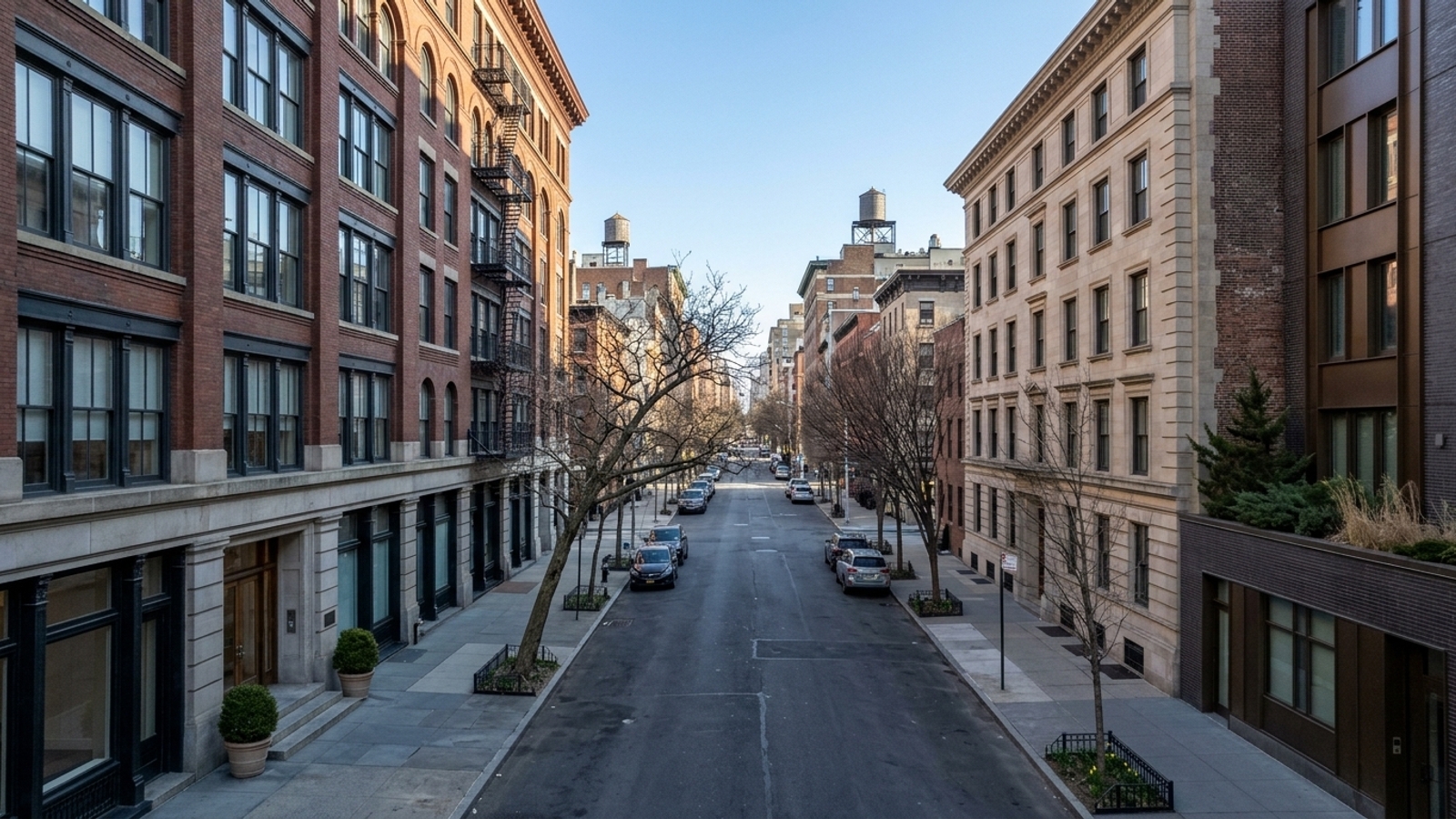
Flatiron's median condo sale price recently hit $1,960,000, up 32% year over year based on 26 sales over the 90 days ending September 30, 2026. Despite that jump, New York City values condominiums and co-ops as if they were income-producing rental buildings and phases in assessment changes over time.
Key Takeaway
Don't estimate a Flatiron condo's property tax as a percentage of its purchase price. NYC values condos as if they were rental buildings, so even with the recent price jump, the bill follows the unit's DOF assessment, not what you pay. Work from the unit's Notice of Property Value and the seller's actual bill, and confirm whether the primary-residence abatement on that bill will carry over to you. For a co-op, ask the managing agent what share of maintenance goes to taxes.
Who This Guide Is For
You're weighing a Flatiron District condo or co-op, or already own one, and need to work out what the annual property tax bill will be and what could change it.
Which Property Tax Checks Apply to You?
If the unit will be your primary residence, you may keep the co-op/condo abatement and qualify for STAR. If you plan to rent it out, budget for the bill without the abatement (see "Property tax abatements if you live in the unit vs rent it out").
Whether it's a condo or a co-op decides where the number comes from. A condo has its own tax lot and a bill you can look up today. A co-op's tax is folded into maintenance and must come from the managing agent (see "Condo vs co-op property taxes in Flatiron").
If the building was built or converted with a 421-a or J-51 benefit, find the expiration year before you bid, because the bill can step up as it phases out (see "Property taxes on new and converted Flatiron buildings"). And if the unit's transitional assessed value is well below its actual assessed value, increases are already scheduled even if nothing changes: compare both figures on the NOPV before you bid.
Flatiron District Property Tax Rate
New York City sets one citywide rate per tax class each fiscal year, so there's no separate property tax rate for the Flatiron neighborhood or for Manhattan as a borough. For fiscal year 2026 (July 1, 2025, to June 30, 2026), the Department of Finance's final Class 2 property tax rate is 12.439%. It applies to all condos and co-ops and replaced the interim rate of 12.340% that had been in effect since July 2025. Class 1 properties, which include one- to three-family homes, have their own rate, though they rarely appear in the Flatiron market.
This rate applies to the property's assessed value, not its market value or the price you pay at closing. That's why applying an effective rate to the price, or using a generic one-percent rule, won't give an accurate estimate for a Flatiron condo. It's also why comparing NYC's rate with other states' rates misleads unless you factor in the city's assessment steps.
How to Estimate the Property Tax on a Flatiron Condo
Because New York City uses an income-capitalization approach for Class 2 properties, you'll need the city's assigned values and the current assessment ratio, not your purchase price.
Find the Unit's Tax Class and DOF Market Value
Look up the unit on the DOF portal described in "How to look up and pay a Flatiron property tax bill." Confirm it's in Class 2 and open its annual Notice of Property Value (NOPV).
The DOF's market value for a condo comes from what comparable rentals would earn, so it can look much lower than a sale price. It's not a valuation of your unit, and it can move year to year for reasons unrelated to your purchase.
Convert Market Value to Assessed Value
Class 2 properties in New York City are assessed at 45% of their DOF-determined market value. The city then applies caps or phase-ins to limit how much your taxable value can rise in a single year. The NOPV shows both an actual assessed value and a transitional assessed value, and the city bills on whichever is lower. The seller's current bill can then understate what you'll pay in years two to five if the transitional assessed value sits well below the actual assessed value.
Subtract Abatements and Exemptions
From the lower assessed value, subtract reductions such as the co-op/condo abatement and the STAR credit. These either reduce taxable value or apply a direct credit against the bill. They belong to the current owner's situation, not the unit, so you keep them only if you meet the primary-residence requirements.
Apply the Class 2 Tax Rate
Take every $100,000 of DOF market value on a condo. The assessment ratio gives an assessed value of $45,000. Multiplying that by the Class 2 rate gives an annual tax of $5,597.55 per $100,000 of DOF market value.
Scale that by your unit's NOPV market value, then subtract any abatement you'll keep. The total is split across quarterly or semiannual bills. Because the rate is reset each fiscal year, an estimate made today holds only for the current tax year.
Condo vs Co-Op Property Taxes in Flatiron
A condominium unit is its own tax lot, so the Department of Finance bills that apartment directly. You can look up the exact amount online before you submit a bid. If you want a tax bill you can verify before you bid, start with a condo unit rather than a co-op apartment.
A co-op building is treated as a single tax lot. The co-op corporation pays the property tax for the entire building and passes the cost to shareholders through their monthly maintenance fees. Any abatements the building qualifies for may also be credited back through that maintenance. With a co-op, you're budgeting a total maintenance figure. Ask the managing agent what share of monthly maintenance is real estate tax and how abatements are passed through to shareholders.
Ask a tax professional whether any portion of your property tax or co-op maintenance is deductible in your situation.
Property Tax Abatements If You Live in the Unit vs Rent It Out
The Cooperative and Condominium Property Tax Abatement reduces property taxes for eligible condo and co-op owners, provided the unit is their primary residence. The benefit uses a sliding scale based on the average assessed value per unit in the development. Units averaging $50,000 or less receive a 28.1% reduction, while those averaging $60,001 and above receive 17.5%. Owners generally can't hold more than three residential units in a single development. Eligibility is based on the unit's status as of the January 5th taxable status date.
If the unit is your primary residence, you may also qualify for the STAR credit or a senior exemption. A buyer who plans to rent the unit out should budget for the full bill without the primary-residence abatement. In that case, the seller's discounted bill is a floor, not an estimate of your future costs.
Ask the seller for the last two years of DOF tax bills and the current Notice of Property Value, and check whether they show a co-op/condo abatement or STAR credit.
Property Taxes on New and Converted Flatiron Buildings
Some newer or recently converted residential buildings carry 421-a or J-51 benefits. These reduce property taxes for a set period and then phase out. A 421-a benefit generally runs 20 years for condominium projects. As a benefit expires, your bill can step up in later years even if the broader market stays flat.
Ask whether the building has a 421-a or J-51 benefit and its end year. Confirm the start and end dates on the DOF's Property Benefit Lookup page before you make an offer.
Flatiron District Housing Market and Your Tax Checks
The pace of the local market gives buyers room to check building financials and tax histories. Flatiron condos recently sat for a median of 83 days on the market, and the area held 5.2 months of supply (90 days ending September 30, 2026). Sellers in this window weren't seeing fast sales, which leaves you time to collect the tax bills and NOPV described above, plus the building's appeal history, before signing a contract. These inventory and time-on-market metrics are tracked in our Flatiron District housing market overview.
Bidding pressure remains low, with only 3.8% of condos selling above list price. A scheduled tax increase or a lost abatement is a fair point to raise during negotiations. Micky Lalchandani can help gather a building's tax documents before an offer. Ask the condo board or managing agent whether the building has a pending assessment appeal (tax certiorari) and how any refunds are distributed to owners.
At a Glance
- Median sale price, condos: $1,960,000 (90 days ending Sept 30, 2026; based on 26 condo sales, so treat with caution)
- Median sale price change, condos: +32% year over year (same window; 26 sales, may reflect the mix of units sold)
- Median sale price, all homes: $1,969,448, +7.6% year over year (90 days ending Sept 30, 2026; based on 28 sales)
- Median price per square foot, condos: $1,604 (90 days ending Sept 30, 2026; 26 sales)
- Median days on market: 83 for condos, 79 for all homes (90 days ending Sept 30, 2026; 26 and 28 sales)
- Sale-to-list ratio: 100% for condos and all homes (90 days ending Sept 30, 2026; 26 and 28 sales)
- Share sold above list: 3.8% of condos, 3.7% of all homes (90 days ending Sept 30, 2026; 26 and 28 sales)
- Months of supply: 5.2 for condos and all homes (90 days ending Sept 30, 2026)
- Homes for sale: 45 condos, 47 homes in total (90 days ending Sept 30, 2026)
How to Look Up and Pay a Flatiron Property Tax Bill
Search by address or borough-block-lot (BBL) number on the DOF's Property Tax Public Access portal to see a unit's tax class and market value, its bills and its Notices of Property Value. The NOPV arrives each January, and quarterly or semiannual statements follow later in the year. The city's ACRIS system shows deeds and sale histories, not tax bills.
Through the city's CityPay system, you can pay by credit card, debit card, pre-paid card or electronic check. A 2% service fee applies to credit, debit, PayPal and Venmo payments. Electronic checks carry no fee unless they bounce. Condo owners pay this bill directly or through a mortgage escrow account, while co-op owners pay their share through monthly maintenance.
Flatiron District Property Tax FAQs
Where Is the Flatiron District, and Which ZIP Code and Borough Do I Use for a Property Tax Lookup?
Use the borough of Manhattan with the unit's block and lot number, or search by street address. A ZIP code alone won't identify a tax lot, and the USPS doesn't draw ZIP codes to informal neighborhood boundaries. The Flatiron District falls within Manhattan Community District 5, which runs from Lexington Avenue to 8th Avenue and from 14th Street to 59th Street.
When Are Property Taxes Due on a Flatiron District Condo?
Properties with an assessed value of $250,000 or less are billed quarterly, with payments due July 1, October 1, January 1 and April 1, including a 15-day grace period. Above $250,000, you're billed semi-annually, with payments due July 1 and January 1.
Are There Limits on How Fast a Flatiron Condo's Assessment Can Rise?
For Class 2 buildings with 10 units or fewer, state law caps assessed value increases at 8% per year and 30% over any five-year period. For buildings with more than 10 units, the Department of Finance phases in changes over five years, applying 20% of the change each year. The sale of the condo itself does not reset the assessment.
Can I Appeal My Flatiron Condo's Property Tax Assessment?
Yes. For Class 2 condominium units, a Tax Commission application for correction must be received by March 1st. Applications received after the deadline are not accepted, even if mailed earlier.
At What Age Can Flatiron Homeowners Get a Senior Property Tax Exemption?
The Senior Citizen Homeowners' Exemption (SCHE) is available to condo and co-op owners 65 or older with a combined annual income of $58,399 or less. The unit must be your primary residence, and you must have held title for at least 12 consecutive months before applying. It reduces the home's assessed value by up to 50%.
How Much Is the Mansion Tax on a $2 Million Flatiron Condo?
The mansion tax is a one-time buyer tax paid at closing, separate from your annual property taxes. On a $2 million residential purchase, the New York State mansion tax is 1%, which comes to $20,000. Rates step up progressively for purchases above that amount.
Do Sellers Pay Transfer Tax When Selling a Flatiron Condo?
Yes. Sellers in New York City pay the Real Property Transfer Tax (RPTT): 1% for sales of $500,000 or less and 1.425% above $500,000. They also pay the New York State Real Estate Transfer Tax of $2 per $500 of consideration, or 0.4%. In new-development purchases, the sponsor often shifts these transfer taxes to the buyer, so read your contract or offering plan carefully.
Sources
- Redfin: Data Center (90 days ending Sept 30, 2026)
- NYC Department of Finance: Property Tax Rates
- Lincoln Institute of Land Policy: NYC Residential Property Tax Guide
- NYC Department of Finance: Testimony on Property Tax Valuation
- New York Explained: NYC Property Taxes
- NYC311: Cooperative and Condominium Property Tax Abatement
- NYC Department of Finance: Senior Citizen Homeowners' Exemption
- NYC311: Property Tax Due Dates
- NYC Tax Commission: Challenging Notice of Property Value
- NYC Department of Finance: Property Tax Public Access
- NYC Housing Preservation and Development: 421-a Tenant Fact Sheet
- NYC311: Real Property Transfer Tax
- Manhattan Community Board 5: District Needs Statement
- NYC311: CityPay Property Tax Payment Options


